
Possession of a controlled substance is a criminal charge that occurs when someone knowingly has illegal drugs or prescription medications without proper authorization. This charge is more common and complex than many people realize, and it can apply even when you’re not actually holding drugs in your hand. Understanding what this charge means and how it works is crucial if you’re facing these allegations.
The Basic Definition
Possession of a controlled substance means having illegal drugs or prescription medications that you’re not legally authorized to possess. The key word here is “controlled”— these are substances that the government has determined need special regulation because of their potential for abuse, addiction, or harm.
You don’t need to be caught in the act of using drugs or selling them to be charged with drug possession. Simply having them in your possession, whether you intended to use them or not, can result in criminal charges.
What Are Controlled Substances?
Controlled substances include both illegal drugs and prescription medications. The federal government classifies them into five categories called “schedules” based on their medical value and potential for abuse:
Common Schedule I Substances
Highest abuse potential, no accepted medical use:
- Heroin
- LSD
- Ecstasy (MDMA)
- Marijuana (under federal law, though many states have different rules)
Common Schedule II Substances
High abuse potential, some medical use:
- Cocaine
- Methamphetamine
- Fentanyl
- Oxycodone
- Adderall
Common Schedule III-V Substances
Lower abuse potential, accepted medical uses:
- Anabolic steroids
- Xanax
- Valium
- Prescription cough medicines
Even prescription medications become “controlled substances” for possession charges if you don’t have a valid prescription or if you have more than prescribed.

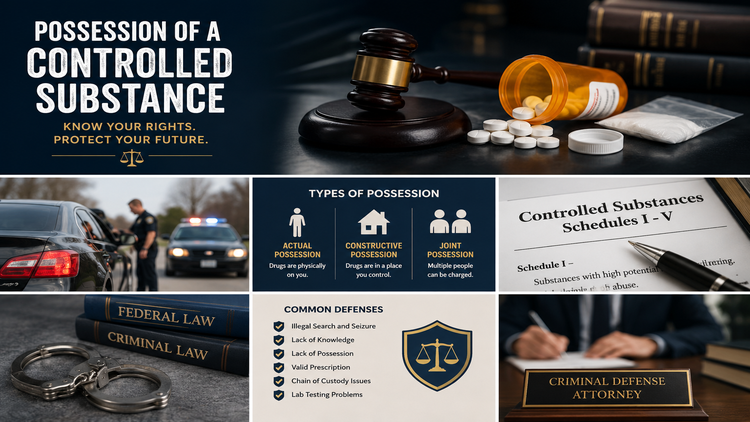
Types of Possession
The law recognizes different types of possession, and you can be charged even if drugs aren’t physically on your person.
- Actual Possession: Drugs are physically on you—in your pockets, purse, or hand. This is the most straightforward type.
- Constructive Possession: Drugs are in an area you control, like your car, home, locker, or office. You don’t need to be physically touching them.
- Joint Possession: Multiple people can be charged for the same drugs if they’re found in a shared space like a car or apartment.
What Prosecutors Must Prove
To convict someone of drug possession, prosecutors must prove several elements beyond reasonable doubt:
- Knowledge: You knew the substance was present and knew it was an illegal drug or unprescribed medication.
- Control: You had the ability to control the substance, either through actual or constructive possession.
- Identity: The substance was actually an illegal controlled substance, typically proven through laboratory testing.
- Lack of Authorization: You didn’t have a valid prescription or legal right to possess the substance.
Common Real-World Examples
Here are some common scenarios that could lead to a possession of a controlled substance charge.
- Prescription Medications: Having someone else’s prescription painkillers, anxiety medications, or ADHD medications without your own prescription.
- Car Searches: Drugs found in your vehicle during a traffic stop, even if they’re not in your immediate reach.
- Home Searches: Drugs discovered in your residence during a search warrant execution.
- Shared Spaces: Drugs found in a dorm room, apartment, or house you share with others.
- Old Prescriptions: Having leftover prescription medications after your prescription has expired.
- Workplace Discovery: Controlled substances found in your work area, locker, or desk.
The Knowledge Requirement Explained
One of the most important elements prosecutors must prove is that you knew about the drugs. This can be challenging in certain situations:
- Actual Knowledge: You definitely knew the drugs were there and knew they were illegal.
- Constructive Knowledge: The circumstances suggest you should have known. For example, drugs in plain sight in your car.
- Willful Blindness: Deliberately avoiding learning about drugs in your possession. Courts may treat this as actual knowledge.
However, if you genuinely didn’t know drugs were present, or if you thought they were something legal, this can be a strong defense.
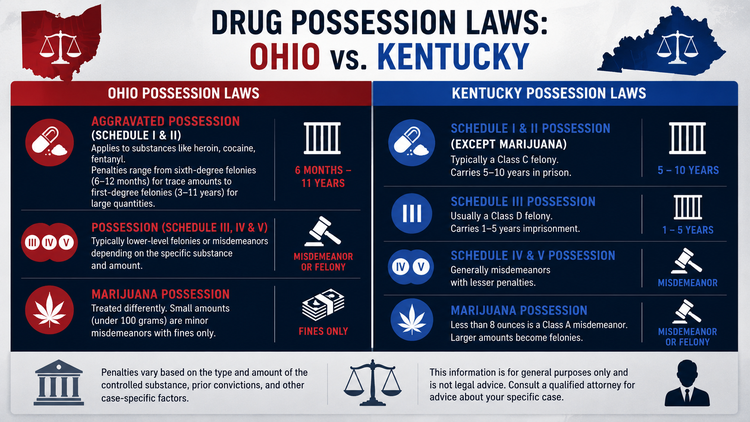
Ohio Possession Laws
Ohio classifies possession charges based on the type and amount of controlled substance:
- Aggravated Possession applies to Schedule I and II substances like heroin, cocaine, and fentanyl. Penalties range from sixth-degree felonies (6-12 months) for trace amounts to first-degree felonies (3-11 years) for large quantities.
- Possession applies to Schedule III, IV, and V substances. These are typically lower-level felonies or misdemeanors depending on the specific substance and amount.
- Marijuana Possession in Ohio is treated differently, with small amounts (under 100 grams) being minor misdemeanors with fines only.
Kentucky Possession Laws
Kentucky takes a slightly different approach:
- Schedule I and II Possession (except marijuana) is typically a Class C felony carrying 5-10 years in prison.
- Schedule III Possession is usually a Class D felony carrying 1-5 years imprisonment.
- Schedule IV and V Possession are generally misdemeanors with lesser penalties.
- Marijuana Possession of less than 8 ounces is a Class A misdemeanor, while larger amounts become felonies.
Defenses to Possession Charges
Below are common defenses to drug possession charges.
- Illegal Search and Seizure: If police violated your Fourth Amendment rights during the search, evidence might be suppressed.
- Lack of Knowledge: You didn’t know the substance was present or didn’t know it was illegal.
- Lack of Possession: You didn’t have actual or constructive control over the substance.
- Valid Prescription: You had a legitimate prescription for the medication found.
- Chain of Custody Issues: Problems with how evidence was handled can lead to dismissal.
- Lab Testing Problems: Substances must be properly tested to prove they’re controlled substances.
- Temporary Possession: In rare cases, brief possession for purposes like disposal might not constitute criminal possession.
Prescription Medication Complications
Many possession cases involve prescription medications, which create unique legal issues:
- Expired Prescriptions: Keeping medications after your prescription runs out can result in charges.
- Sharing Medications: Giving your prescription medications to others, even family members, is illegal.
- Doctor Shopping: Getting the same medication from multiple doctors without disclosure can lead to possession charges.
- Pill Counting: Having more pills than your prescription allows, even if you have a valid prescription, can result in charges.
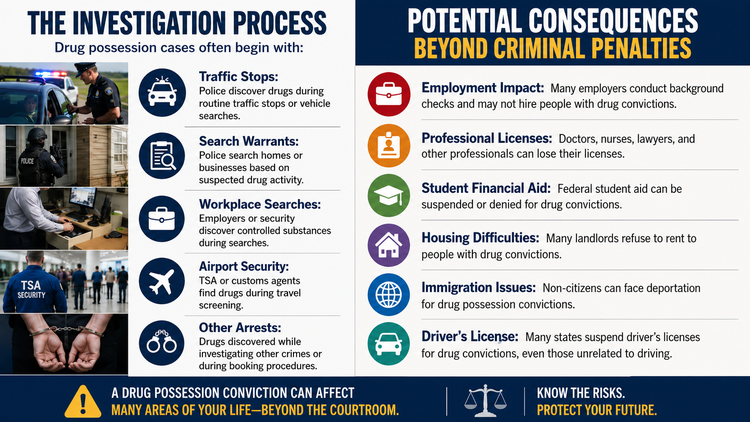
The Investigation Process
Drug possession cases often begin with:
- Traffic Stops: Police discover drugs during routine traffic stops or vehicle searches.
- Search Warrants: Police search homes or businesses based on suspected drug activity.
- Workplace Searches: Employers or security discover controlled substances during searches.
- Airport Security: TSA or customs agents find drugs during travel screening.
- Other Arrests: Drugs discovered while investigating other crimes or during booking procedures.
Potential Consequences Beyond Criminal Penalties
Apart from criminal penalties, drug possession charges can impact your life in a variety of ways. Examples of negative consequences include:
- Employment Impact: Many employers conduct background checks and may not hire people with drug convictions.
- Professional Licenses: Doctors, nurses, lawyers, and other professionals can lose their licenses.
- Student Financial Aid: Federal student aid can be suspended or denied for drug convictions.
- Housing Difficulties: Many landlords refuse to rent to people with drug convictions.
- Immigration Issues: Non-citizens can face deportation for drug possession convictions.
- Driver’s License: Many states suspend driver’s licenses for drug convictions, even those unrelated to driving.
Why Intent Doesn’t Always Matter
Many people think they can’t be charged with possession if they weren’t planning to use or sell the drugs. This isn’t true. The law focuses on whether you knowingly possessed controlled substances, not on what you planned to do with them.
However, the amount and circumstances can affect whether you’re charged with simple possession or more serious charges like possession with intent to distribute.
Getting Help Early Makes a Difference
If you’re facing possession charges, early legal intervention can make a significant difference in your case outcome. Hiring a criminal defense lawyer early on can benefit you in several ways. For example:
- Evidence Preservation: Important evidence like video footage or witness statements can disappear quickly.
- Constitutional Challenges: Issues with illegal searches must be raised promptly or they may be waived.
- Plea Negotiations: Early attorney involvement often leads to better plea deals.
- Diversion Programs: Many alternative programs have application deadlines or requirements that must be met early.

Don’t Face These Charges Alone
Possession of controlled substances charges are more complex than they appear on the surface. The consequences extend far beyond potential jail time, affecting your ability to work, go to school, find housing, and maintain professional licenses.
At Monohan & Monohan, we understand the serious nature of drug possession charges and the many defenses that may be available in your case. We thoroughly investigate every aspect of your situation, from the legality of the initial search to the handling of evidence, to build the strongest possible defense.
Whether this is your first encounter with the criminal justice system or you’re facing enhanced penalties due to prior convictions, we’re here to protect your rights and fight for the best possible outcome.
Don’t let a possession charge derail your future. Contact us immediately for a confidential consultation to discuss your case and explore all available legal options.
This information is for educational purposes only and does not constitute legal advice. Controlled substance laws are complex and vary by jurisdiction. Each case involves unique facts that affect potential charges and defenses.
